
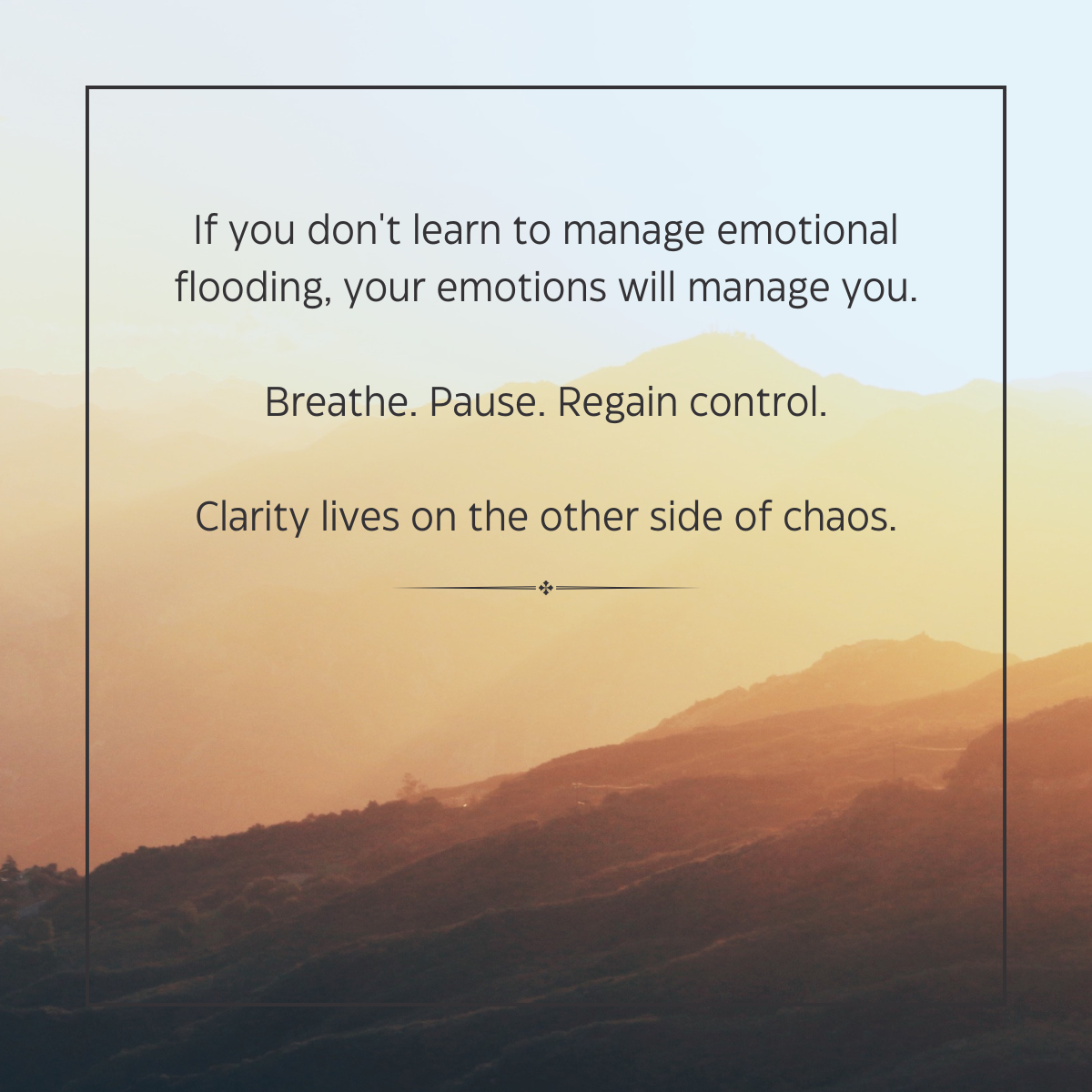
Emotional flooding is what happens when your nervous system gets hijacked.
Your heart pounds.
Your thoughts blur.
Your fight-flight-freeze system kicks in.
And suddenly, you are no longer solving problems.
You are trying to survive the moment.
This is not weakness. It is human biology.
But here is the good news:
You can learn to manage it.
Here are a few practical steps that have helped me (and many others) respond better, not just react:
- Hit pause, not people.
When your emotional intensity spikes, give yourself space. Step out. Breathe. Let your body come back to baseline. Let others know you’ll return once you’re thinking clearly. - Breathe like it matters.
Because it does.
Inhale through your nose for 4 seconds.
Hold for 4 seconds.
Exhale slowly for 4 seconds.
Repeat this simple pattern. You will feel calmer. This is you rewiring your nervous system. - Ground yourself in the present.
Look around. Feel your feet on the floor. Notice the texture of your shirt. Focus on what is real right now. It pulls your brain away from emotional chaos and into clarity. - Name it to tame it.
Say the emotion aloud:
“I’m angry.”
“I feel embarrassed.”
“I am overwhelmed.”
The simple act of naming what you feel reduces its grip on your thinking. - Shift the inner voice.
Replace “I can’t handle this” with “This is tough, but I’ve handled worse.”
Or even, “I just need a minute.”
You are not lying to yourself. You are reminding yourself of your strength. - Move.
Shake off the stress. Walk it out. Stretch.
Physical motion clears emotional static. - Mindfulness is your secret weapon.
You don’t need to sit in silence for hours.
But 5 minutes a day of focused breathing or meditation trains your mind to stay steady during chaos. - Revisit the conversation—later.
When the storm passes, go back with calm. Speak using “I” statements. Stay assertive, not aggressive.
Example: “I felt overwhelmed during that discussion. Can we try again?” - Learn your early warning signs.
Journaling, reflection, and even chatting to a trusted friend or therapist can help you identify what sets you off.
Catch the flood before it begins. - Prioritise your emotional fitness.
This means regular sleep.
Nourishing food.
Time in nature.
A hobby that makes you forget your phone exists.
You do not have to earn self-care. You need it to perform at your best.
Because here is the truth:
You can be smart, capable, experienced and still find yourself spiralling when emotions run high.
What separates those who thrive under pressure is not talent. It is regulation.
Emotional mastery is not about ignoring your feelings. It is about learning to lead them.
If you want to lead others, manage crises, or just be better in conflict—this is the skill you cannot ignore.
Start small. Stay consistent.
And when the next storm hits, you will not be overwhelmed.
You will be ready.